



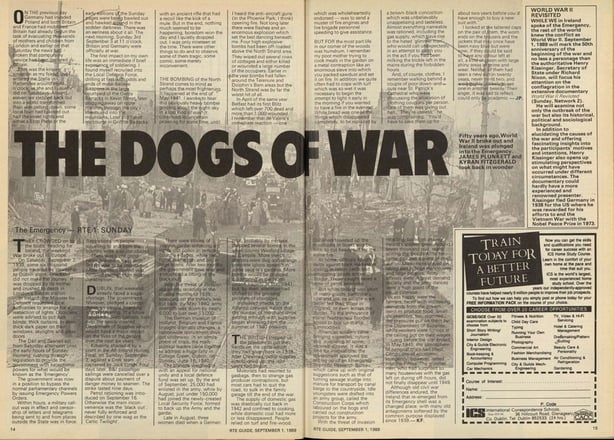
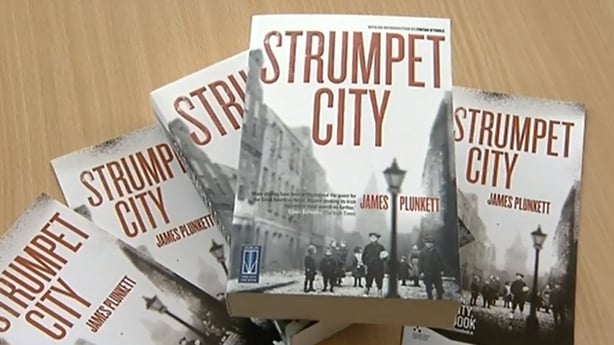
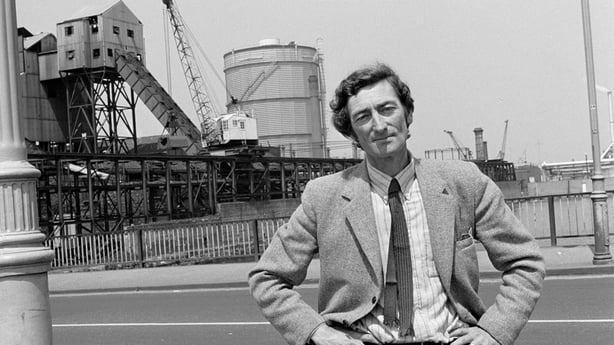
Every week we take a look in the RTÉ Guide archives to check out the stories from years gone by. On this week in 1989, RTÉ marked the 50th anniversary of the beginning of World War II with a television documentary on The Emergency, as the war years were commonly known in Ireland at the time. To mark it, the acclaimed novelist, scriptwriter and producer James Plunkett wrote a piece for the RTÉ Guide on his own wartime memories. You can read it here in full.
On the previous day Germany had invaded Poland and both Britain and France had mobilised. Britain had already begun the task of evacuating thousands of mothers and children from London and earlier on that Saturday the news had broken that compulsory service been declared in Britain.
That was the known situation as my friend and I entered the Stella [cinema] in Rathmines around eight o'clock, as she and I usually did on Saturdays. Around eleven we stepped back out into a world transformed. Rain was pelting down. Some local fault had blacked out half the street lights and either a Stop Press or the early editions of the Sunday pages were being bawled out and hawked around in the sodden darkness. There was an eeriness about it all. Then next morning, Sunday 3rd September at 11 o'clock, Britain and Germany were officially at war.
The first impact on my own life was an immediate if brief experience of soldiering. I found myself recruited into the Local Defence Force, drilling at first with odds and ends of make-believe weapons in the large courtyard of the Garda Barracks in Kevin Street, later slogging away on route marches through the city's streets and into the mountains. Later still I shot my course in Griffith Barracks with an ancient rifle that ha da recoil like-the kick of a mule.
But in the end nothing much seemed to be happening, boredom won the day and I quietly dropped out. I was only nineteen at the time. There were other things to do and to observe.some of them tragic, some comic, some merely inconvenient.
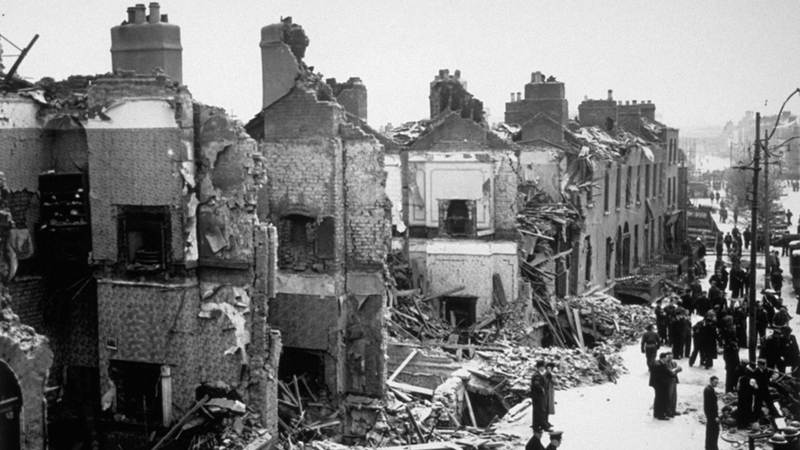
THE BOMBING of the North Strand comes to mind as perhaps the most frightening.It happened at the end of May 1941. I awoke to hear this obviously heavy bomber groping about the night-sky in a lost klnd of way. It continued its uncertain prowling for some time, until I heard the anti-aircraft guns (in the Phoenix Park. I think) opening fire. Not long later there were flashes and an enormous explosion which set the bed dancing beneath me. Four high explosive bombs had been off-loaded above the North Strand area.They wiped out several rows of cottages and either killed or wounded a large number of the occupiers. Earlier in the year bombs had fallen around the Terenure and Dolphin"s Barn areas but the North Strand was by far the worst hit of all.
In April of the same year Belfast had its first Blitz which left over 700 dead and more than 1000 wounded. I remember that de Valera's immediate reaction - one which was wholeheartedly endorsed - was to send a muster of fire engines and fire brigade personnel speeding to give assistance.
BUT FOR the most part life in our corner of the woods was humdrum. I remember my poor mother trying to cook meals in the garden on a metal contraption like an enormous sieve into which you packed sawdust and set it on fire. In addition we quite often had to cope with turf which was so wet it was necessary to begin the attempt to light it early in the morning if you wanted to have a fire in the evening.White bread was one of the things which disapoeared completely, to be replaced by a brown-black concoction which was unbelievably unappetising and tasteless.
Almost everything nameable was rationed. including the gas supply, which gave rise to the hated 'glimmer man' who would call unexpectedly in an attempt to catch you in the act if you had been milking the trickle left in the mains during the forbidden hours.
And of course, clothes. I remember walking behind a couple of poor down-and-outs near St. Patrick's Cathedral who were discussing the allocation of clothing coupons per person. One of them w as giving out hell "They're useless," he was complaining, "You'd have to save them up for about two years before you'd have enough to buy a new suit with."
I looked at the tattered caps on the pair of them, the worn ends on the trousers and the jackets that may once have been navy blue but were, if they could be said to have any colour left at all, a kind of green with large shiny areas of grime and wear. Neither of them had seen a new suit in twenty years. never mind two, and were highly unlikely to see one in another twenty. Their anger, it was sad to reflect,could only be academic.
