


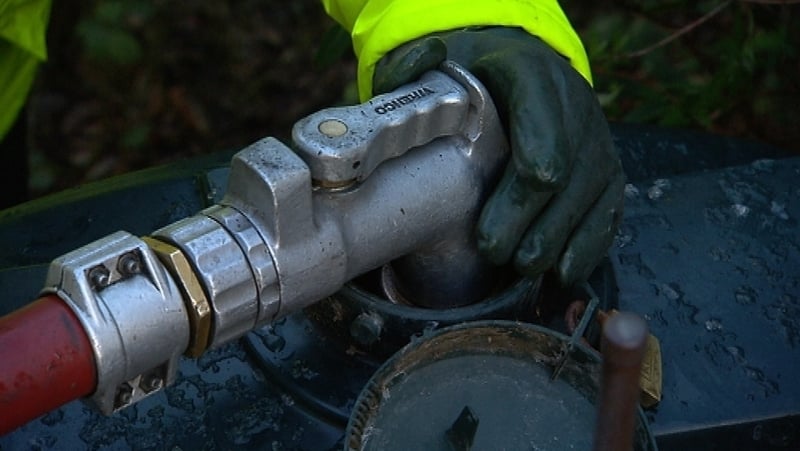
The Minister for Public Expenditure has said that a lower rate of carbon tax on home heating oil is being considered for the Budget, but that Government "cannot insulate" the public from "every price change globally".
Jack Chambers said there are trade-offs and choices with regards to the Budget, adding that "we have to ensure that we get the balance right".
He said he has put reform and efficiencies and "wider productivity" at the centre of all the discussions he is having with ministers ahead of the Budget on 6 October.
"But also, how do we help people over the winter period," he said on RTÉ's Today with David McCullagh.
"It is about getting the balance right, between the short-term demands and the pressures of today."
He said it was important to protect Ireland in a "period of significant risk within the global economy".
The cost of a standard size of a household tank of oil has increased by 59% when compared to September of last year, due to the disruption of global oil supply with the ongoing war in Iran.
The minister said his priorities are targeting changes to fuel allowance, giving people certainty on petrol and diesel and the potential extension of excise cuts into the early Spring.
Excise cuts on petrol and diesel, which were first introduced in April, were set to be unwound from the beginning of November.
The cuts resulted in a 32 cent lowering of the price of a litre of diesel while 27 cent was shaved off the cost per litre of petrol.
"We know that home heating oil is a specific issue for many families that have no alternative and that is why we are examining how we treat home heating oil in the context of the carbon tax," he said.
He said a lower rate of carbon tax on home heating oil is an "absolute consideration".
The Fianna Fáil minister said he supports the carbon tax.
"We have provided temporary deferrals … we are examining and reviewing that presently in the context of the winter period," he said.
When asked about the price of diesel, the minister said "we cannot and we will not be able to chase every global price change".
"We can't insulate every price change globally," he said.
He said the Government cannot have permanent deferrals "in terms of our tax treatment of fossil fuels and other measures".
The central factor of the Budget is to protect investment in infrastructure and housing, the minister said.
"That is ultimately what will grow our economy, that is what will ensure people have a better day-to-day experience going to work, reducing congestion.
"But also, the thousands of homes that we need to build, that that capital investment is protected over the next number of years," he said.
The minister said people want to see the State work better and the Budget improve their experience of how they interact with the Government and the State.
He said they have "massively prioritised investment" and that is ultimately what will build growth and resilience for the economy.
"Just meeting every short-term pressure isn’t what will deliver a better State," he said.
He said that wider spending, such as day-to-day spending, needs to be challenged which is "something I am doing in the Budget".
