


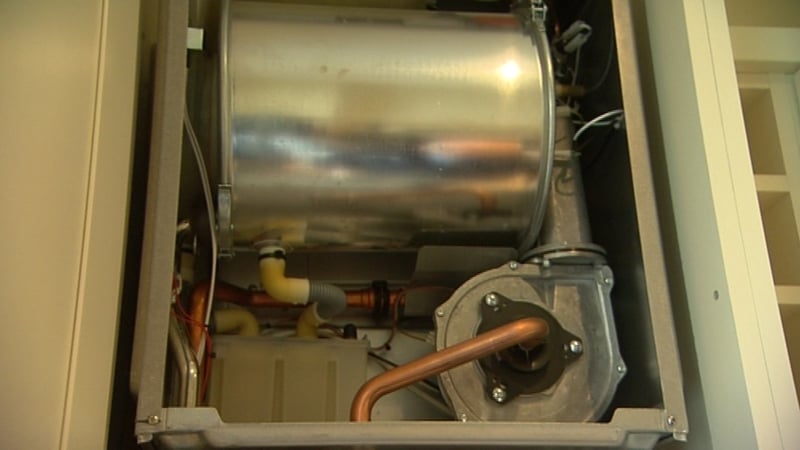
The Government has approved a significant expansion of home energy grants, including a new additional €2,000 payment to encourage households to scrap fossil fuel heating systems and switch to heat pumps or other renewable heating.
It has also approved a new €600 grant for domestic battery storage, while some lower-income households will be eligible for grants of up to €9,000 to install solar panels and batteries.
The measures are part of a package of enhanced retrofit and renewable energy supports announced by the Minister for Climate, Energy and the Environment, Darragh O'Brien.
Most will begin to open from October, although the new €2,000 boiler scrappage scheme will not come into effect until early next year.
However, all eligible homeowners with a heat pump application already in progress will be given the additional boiler scrappage grant of €2,000.
The Government says the changes are intended to reduce household and business energy bills, accelerate the move away from imported fossil fuels and make renewable energy technologies available to a wider range of households.
One of the most significant measures is the new boiler scrappage scheme, which will provide €2,000 towards replacing fossil fuel heating systems in houses built before 2021 with a heat pump or other renewable heating system.
This will be additional to the substantial increases in heat pump grants already introduced this year.
Existing supports of up to €12,500 are available towards installing a heat pump and making associated changes to a home's heating system where the eligibility requirements are met.

The additional €2,000 means potential State support for households moving away from fossil fuel heating could increase further, although the SEAI has yet to publish the detailed eligibility and application rules for the new scheme.
A separate grant of €600 is being introduced for home battery energy storage systems.
Until now, the State has provided grants towards installing solar photovoltaic panels but not for standalone domestic battery storage.
The Government estimates that a battery could produce savings of up to €137 a year, while a battery installed alongside a 4 kilowatt peak solar PV system could contribute to combined household energy savings of up to €878 annually.
Eligibility for the existing €1,800 solar PV grant and the solar thermal grant is also being widened.
At present, these are generally confined to homes built and occupied before 2021. That cut-off will now be extended to homes built and occupied before 2025, bringing thousands of newer properties within the schemes.
Some of the largest increases in support are being targeted specifically at households considered particularly vulnerable to high energy costs.
Under the Warmer Homes Scheme, qualifying lower-income households will be offered fully funded solar PV systems of up to 4 kilowatt peak together with a 5 kilowatt-hour battery.
Similar systems will be fully funded under the Solar PV for the Medically Vulnerable Scheme.
Homeowners receiving certain qualifying social welfare payments will be able to obtain grants of up to €9,000 towards a 4 kilowatt peak solar system and 5 kilowatt-hour battery.
The qualifying payments include Fuel Allowance, Working Family Payment, One-Parent Family Payment and Domiciliary Care Allowance, as well as certain recipients of Jobseeker's Allowance, Carer's Allowance and Disability Allowance.
A pilot scheme will also provide grants covering 100% of the median cost of solar PV and battery installations in qualifying Rental Accommodation Scheme tenancies.
We need your consent to load this rte-player contentWe use rte-player to manage extra content that can set cookies on your device and collect data about your activity. Please review their details and accept them to load the content.Manage Preferences
Energy transition
Homes in Housing Assistance Payment and Rental Accommodation Scheme tenancies will become eligible for enhanced insulation grants of between €1,400 and €2,500 for attic insulation and between €900 and €2,300 for cavity wall insulation, depending on the type of house.
Mr O'Brien said many households and businesses continue to face pressure from high energy costs and that recent developments in international energy markets had again highlighted the risks associated with Ireland's reliance on imported fossil fuels.
"A particular focus of this package is ensuring that households most exposed to high energy costs can benefit from the energy transition," he said.
"Enhanced supports for households at risk of energy poverty, medically vulnerable customers, lower-income homeowners and renters will help ensure that those who need support most can access the benefits of lower energy bills."
The package also includes increased support for businesses installing solar panels, heat pumps and solar thermal systems, although the Department has not yet published the revised grant rates.
Sharp rise in demand for schemes
The Government says businesses availing of the enhanced solar PV supports could potentially reduce their energy costs by up to €300,000 a year, depending on the scale and circumstances of the business.
SEAI Chief Executive William Walsh said demand for energy upgrade schemes had increased sharply this year, with applications to some programmes increasing by more than 200%.
"The only long-term solution to high energy bills is to stop relying on the fossil fuels that drive them, and the best way to do that is through retrofit," he said.
The Government allocated a record €640 million for residential retrofit programmes this year and has set a target of completing 73,000 home energy upgrades during 2026.
More than 88,800 applications were processed between January and August, an increase of 116% compared with the same period last year.
Since 2019, more than 287,000 home energy improvements have been supported through SEAI residential schemes, involving State investment of more than €2 billion.
More than 39,500 homes have received fully funded upgrades under the Warmer Homes Scheme, while more than 120,000 homes have received support to install solar PV.
Most of the newly announced measures will become available from 6 October, subject to final implementation arrangements. Others, including the boiler scrappage scheme, will formally commence in the first quarter of 2027.
The SEAI will publish detailed eligibility criteria, grant rates and application procedures before each of the new measures opens.
Mr O'Brien said further energy affordability measures will be considered as part of Budget 2027, while a new Energy Affordability Action Plan is due to be published next month.
Read more: EU warns of 'very high' energy prices as 'challenging' winter looms
