


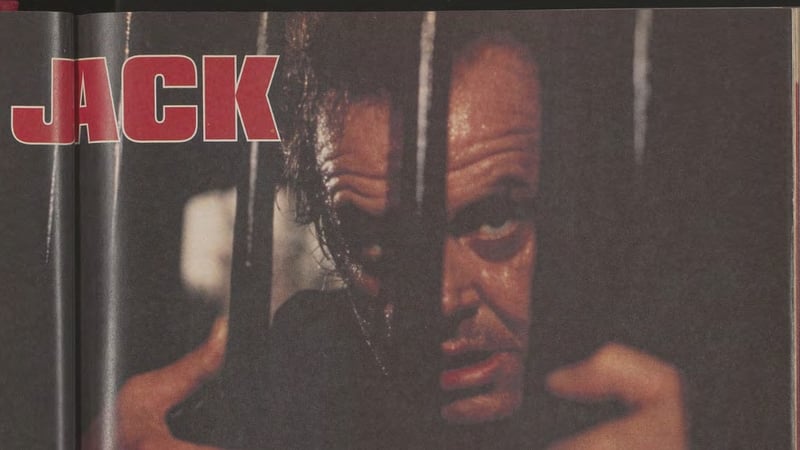

Every week we take a look in the RTÉ Guide archives to check out the stories from years gone by. On this week in 1994, the Guide's Michael Doherty went to London to meet a true Hollywood legend. Jack Nicholson was in Europe to promote Wolf, made by his old collaborator Mike Nichols. And he didn't disappoint.
"The first thing you notice is the dark glasses," wrote Doherty. "Four o'clock in the afternoon in a dimly-lit hotel room in London and Jack is wearing his trademark shades. Most celebrities don sunglasses so they can travel with a degree of anonymity. With Jack, the opposite comes into play; to travel incognito, he would need to expose his eyes to the world. But then he wouldn’t be Jack. And that would be a great shame,because Hollywood needs larger-than-life characters and they don’t come much larger or more lively than Jack Nicholson."
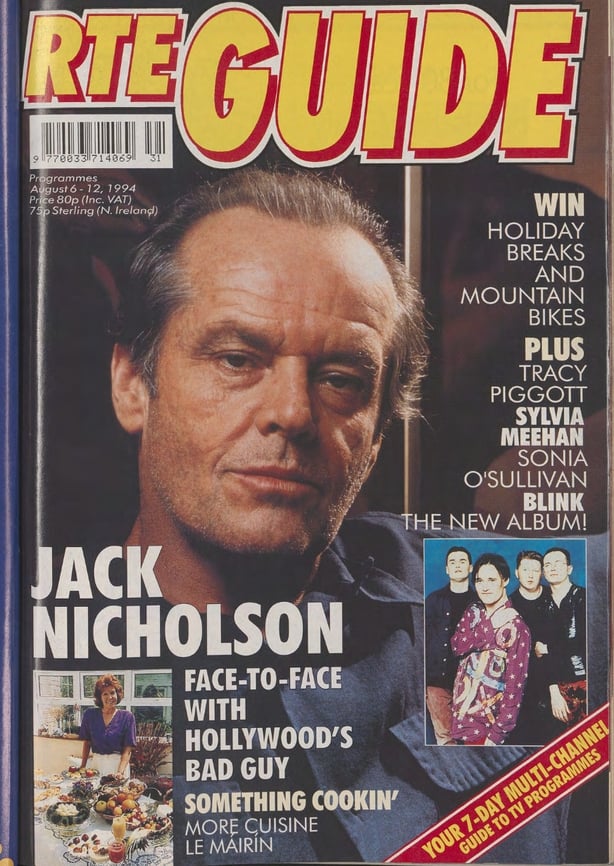
As Doherty reminds us, Nicholson was on something of a roll in the '90s. "Were a caricaturist to tackle Mr Nicholson, he would probably end up with little more than a hairline,dark glasses and one arched eyebrow. The real McCoy is nattily dressed in white chinos, a grey linen jacket and black polo-neck, rounded off with the coolest footwear this side of George Raft. Mad, bad and dangerous to know? Maybe, but today Jack looks every inch the wealthy, well-respected, eminence grise of his profession.And why wouldn’t he? Having recently turned in a scenery-chewing performance in A Few Good Men and just wrapped Sean Penn’s eagerly-awaited The Crossing Guard, Jack is in London to promote Wolf, in which our hero plays a book editor bitten by an injured wolf who then .... well, you can guess the rest. Suffice it to add that Michelle Pfeiffer is on hand to provide thel ove interest and Mike Nichols is behind the camera."
Despite his larger than life reputation, Nicholson saw himself as a good collaborator. "'There's a little of the wolf within us all,' Jack concedes. 'I’ve always felt a little bit endangered but then I’m complicated in terms of self-protection. I always act out a character, and tell everybody I’m directing to act out a character, so the film becomes their story. If s about them, no matter how large or small the character is. If I’m doing a bit too much they can say 'a bit less, Jack, please’. But I’m very easy to talk to and to direct. It’s just not too many people have ideas that are better than my own ... I’m only kidding.' You always know when Jack is kidding. The eyebrow goes skyward and the eyes narrow. Bad habit for a poker player but useful for a man who has made his reputation playing a guy who, as Billy Wilder once pointed out "has this tremendous ability at any given moment to say ‘why don’t you go f*** yourself.'"
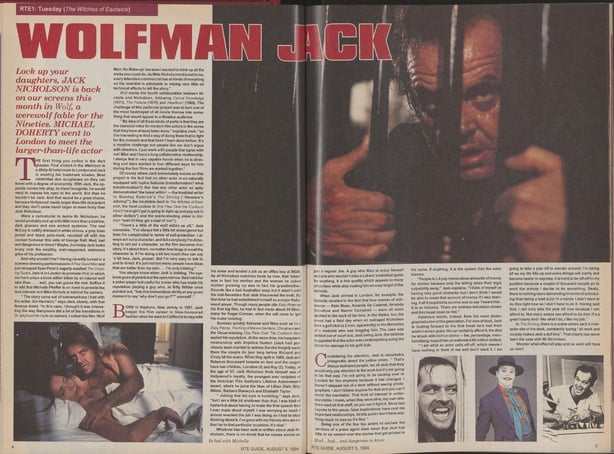
Nicholson was very much a tabloid staple in this era, as Doherty reminded readers of the RTÉ Guide: "When Jack arrived in London, for example, the tabloids revelled in the fact that four women of substance — Kate Moss, Amanda De Cadenet, Amanda Donohoe and Naomi Campbell — were all soon spotted in the back of his limo," he writes. "In the States, too, th epress had a field day when an outraged Nicholson took a golf club (a 2-iron, apparently) to the Mercedes of a motorist who was bugging him. The case was settled out of court but, Jack being Jack, the tabloids suggested that the actor was contemplating suing the driver for damage to his golf club."
Nicholson seemed to accept the fact that this media attention was part of his life, even if he didn't like it much. "That's always bothered people, we all wish that they would only pay attention to the work but it's not going to be that way," he told Doherty. "I’m not going to be coming over to London for fun any more because it has changed. I haven’t stepped out of a door without seeing photographers. I don’t blame anyone for that and you can't resist the inevitable. That kind of interest in understandable. I mean, when they were alive, my own relatives read all that stuff, so you can’t fight it Since last I spoke to the press, false implications have cost me important relationships. At this point I don’t have anything much to lose so it’s fine."
He understood why people sold stories to the tabloids and gossip TV shows. "If anything, it is the system that the actor blames," wrote Doherty. "'People in LA pay tremendous amounts of money for stories because only the telling takes their legal culpability away," Jack explains. "I think of myself as having very good character but I don't think I would be able to resist that amount of money if I was starving, if all it required to survive was to say 'I heard this’.It is an industry. There are endless television shows and this beast must be fed.'"
After a few intense years, Nicholson told Doherty he was now planning to take a year off, acknowledging that his financial success enabled him to do so. Doherty wasn't sure what "In The Shining, there is a scene where Jack's character sits at his desk, constantly typing 'all work and no play makes Jack a dull boy'," he wrote. "That clearly has never been the case with Mr Nicholson. Wonder what effect all play and no work will have on him?"
