


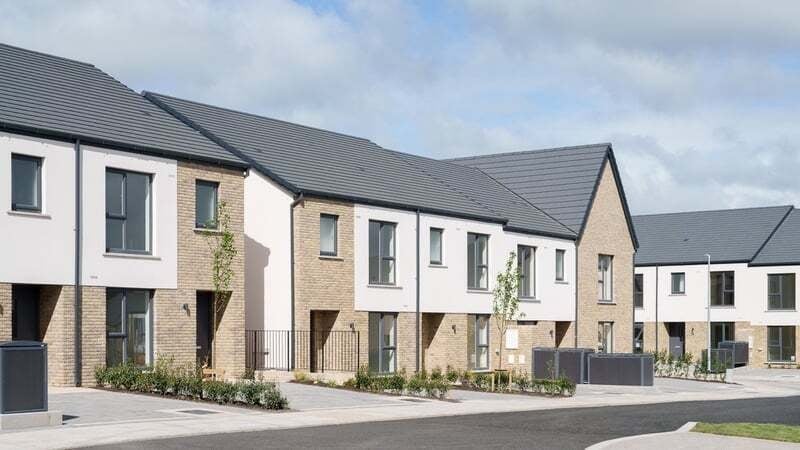
The Tánaiste and Minister for Finance has said the Government has been "working to fix" the delays in the delivery of key infrastructure for housing.
Simon Harris, who was speaking at the European Parliament in Strasbourg, said the issue is one of the reasons the Critical Infrastructure Act was introduced.
He said housing is "an emergency in Ireland, housing is an emergency in Europe" and he said "if you want to fix housing, you've got to also fix the enabling infrastructure".
His comments came after the Central Bank said it is taking longer to build homes with the time from initial lodgement of planning application to completion of a home taking four years - twice as long as a decade ago.
The report said the increased timeline is being linked to developers facing difficulties getting water and electricity connections for sites.
The bank called for implementation of reforms to speed up the delivery of "key national infrastructure" to help housing delivery.
Minister Harris said the Critical Infrastructure Act is "only bedding in" but he said it allows the Government to prioritise the delivery of certain infrastructure.
"More and more, when I engage with local authorities, when I engage with industry, to build more homes, it's often about the water plant, the wastewater plant, the connection in terms of the roads."
"I think the Central Bank view and the Central Bank report is an important reminder. It's one that Government takes extraordinarily seriously, but it's also very much consistent with our programme of work," he added.
The Tánaiste also said the Housing Activation Office has received fund of funding by €1 billion, which he said is "now providing direct funding to local authorities to deal with those infrastructural deficits".
Sinn Féin housing spokesman Eoin Ó Broin said: "I'm not suprised by the Central Bank report. It is the way the indicators have been going."
He claimed the Government has not been listening to local authorities, developers or the opposition.
Mr Ó Broin called on the Government to put investment strategies and policy changes in place to allow public and private homes to be delivered.
Social Democrats housing spokesman Rory Hearne said the Central Bank's figures were "further proof" the Government's housing targets were a "fantasy."
The Tánaiste and Minister for Finance has said the Government has been "working to fix" the delays in the delivery of key infrastructure for housing.
We need your consent to load this rte-player contentWe use rte-player to manage extra content that can set cookies on your device and collect data about your activity. Please review their details and accept them to load the content.Manage Preferences
Housing now taking twice as long to be completed - Central Bank
The Central Bank has revised downwards its forecast for how many homes will be built between now and 2028, and said it is taking twice as long for houses and apartments to be completed.
The bank has reduced its projections for how many homes will be built this year by 500 to 39,500.
It predicted the figure will be 41,000 next year, down 2,000 from its previous estimate, and will be 45,000 in 2028 down 1,000 from its earlier forecast.
The Central Bank also said it is taking longer to build homes with the time from initial lodgment of planning application to completion of a home taking four years - twice as long as a decade ago.
This is being linked to developers facing difficulties getting water and electricity connections for sites.
The bank called for implementation of reforms to speed up the delivery of "key national infrastructure" to help housing delivery.
It said it believes more than 50,000 homes need to be built annually to satisfy pent up demand.
"Planning permissions have stagnated with an annual average of approximately 35,000 arising since 2023," the Central Bank said.
It added that commencements amounted to approximately 16,000 homes in the first half of this year.
However, it pointed out that there has been a 12% increase in mortgages for new homes.
The Central Bank said population growth is now at the upper end of projections, which is expected to add to demand for housing.
Central Bank revises economic growth forecast up to 3.8%
The Central Bank today revised upwards its growth forecast for the domestic economy by half a percentage point to 3.8% for this year and 3.4% for 2027.
It said faster expansion in the economy is being driven by a substantial rise in demand for software and data centre equipment by multinationals linked to the growth of AI.
We need your consent to load this rte-player contentWe use rte-player to manage extra content that can set cookies on your device and collect data about your activity. Please review their details and accept them to load the content.Manage Preferences
But it said the economy is also being helped by strong consumer spending while the savings rate for Ireland is now the highest among countries which use the euro.
"The growth in the economy has delivered employment growth, higher incomes and increased government revenue," it said.
But it urged the Government not to add to strong growth by adding any further stimulus in the budget.
It said the spending limits outlined by the Government in the Summer Economic Statement "should be adhered to" in next month's budget.
It said this would limit exposure to volatile corporation tax receipts "concentrated among a small number of multinational firms".
Its comments come as the Irish Fiscal Advisory Council will tell the Oireachtas Committee on Budgetary Oversight later today that Government spending is likely to exceed targets by €1.4 billion this year.
The chief economist at the Central Bank, Robert Kelly, said the mild revisions to its housing forecasts is due to the slower momentum seen in the first half of this year, as well as a new data set which allows the bank to look at an individual house level - what is happening between the time of planning, commencement of building and completion.

"We've seen a long increase in the delays between planning and the commencement, which might link to infrastructure delays, for example. Once building starts, it's also taking eight to 12 months longer for building to complete compared to a decade ago," Mr Kelly said.
He explained that the delay is potentially due to connections for water and electricity.
The Government has approved almost €13 billion in investment for water infrastructure, and another almost €13 billion for the electricity grid in recent years, which Mr Kelly said "are really, really important" for reducing those delays.
The economist also said there is not enough workers in the construction sector.
"So, we need to think of ways, how can we get more housing from the same stock of workers, more modern methods of construction, for example, thinking about how we can utilise that labour better," he stated.
Mr Kelly said that the Central Bank is predicting just under 40,000 house completions for this year, rising into the early 40,000s for next year and then up towards to 45,000 for 2028.
He also said the country is seeing population growth at the strongest level relative to where CSO might have predicted it be.
"So, we do need that 50,000 units of housing plus if we're going to start to see balance in the housing market and start to see some of these supply being addressed the imbalance between supply," the said.
He said there could be some increases if there are more reductions in that gap between time to planning and commencement.
We need your consent to load this rte-player contentWe use rte-player to manage extra content that can set cookies on your device and collect data about your activity. Please review their details and accept them to load the content.Manage Preferences
But he also addressed the issue of costs, adding that a lot of the raw materials for housing come from the Middle East. He said there are blockages there with aluminium being seriously affected.
In relation to economic growth this year, Mr Kelly said there are two main factors behind that the higher forecasts.
He said that 40% of all growth is linked to "business equipment investment" - which is mainly they outfitting of data centres in Ireland.
"We've seen a huge increase in imports coming in of this equipment. Some of it goes into supply chains, goes back out of the country - think of big manufacturers of computer chips - but the rest of it is going into data centres," he said.
"And not the build of them, the equipment that's in them. And what's crucial here is how long this lasts," he added.
He said the second element driving the growth actually is consumption - consumer spending.
Despite high levels of inflation and energy prices rising, people are still consuming and spending quite a lot, he noted.
He also cited "the savings buffer", adding that CSO data shows that households actually have considerably higher income than first thought, about €4,000 extra, relative to last year, and they have saved that.
Government aware housing taking 'far too long' - minister
Minister for Higher Education James Lawless has said the Government is very aware that housing construction and building infrastructure is taking far too long.
Speaking on his way into Cabinet, he said: "If we take a house that takes four years to build, two-and-a-half of those were in the previous government.
"It's a year-and-a-half into this Government, and maybe a little more.
"We're very aware that housing, construction, building infrastructure takes far too long.
"Procurement takes too long, planning takes too long, the various appeals and core challenges take too long, and the processes are far to run out."
He said in order to address this, Government ministers have been trying to fast-track planning and accelerate infrastructure.
"We've tried to bring forward planning exemptions so that simple modifications no longer need a planner to spend time on them, and the whole extra that goes with that.
"And in many many ways, we'll accelerate infrastructure.
"Minister (for Public Expenditure Jack) Chambers has agreed to see the seven or nine projects to be fast route because they're of critical importance.
"Things like the Dublin area drainage scheme and many others around the country as well."
"So we're absolutely acutely aware of the unacceptable delays and and time it takes to build significant projects, you know, including housing, and that's exactly why we're acting on it in such a significant way," he added.
Additional reporting: Harry Manning
