




Analysis: Without realising it, Irish hotels and restaurants are already teaching their staff the skills UNESCO says it needs for sustainable development
"You have to change the mindset of the chefs and start looking at the mise-en-place waste bowl as another bowl for ingredients."
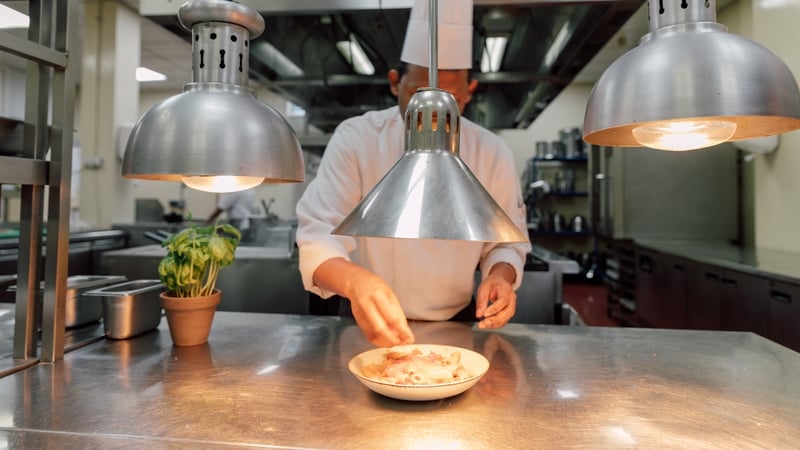
That's how the head chef of a small Irish restaurant described teaching staff about sustainability. In most kitchens, the waste bowl collects the peelings, stalks and offcuts from the morning's prep, and it all ends up in the bin. Here, staff learn to see that bowl as the makings of a stock, a sauce, or plate decorations. No classroom, no certificate, just a new way of looking at a bowl of trimmings.
Tourism and hospitality leave a heavy footprint, from food waste and energy use to carbon emissions. In Ireland alone, hotels, restaurants, pubs and cafés threw away 181,000 tonnes of food in 2024. As the sector tries to go greener, much depends on whether the people who work in it have the right skills. Our study set out to discover how Irish tourism businesses are training their staff for this.
We interviewed 15 owners, general managers, chefs, and HR managers working in hotels, restaurants, visitor attractions, tour operators and organisations that promote tourism, ranging from small-to-medium-enterprises (SMEs) to large organisations. Every one of them was teaching sustainability competencies. Almost none of them called it that.
We need your consent to load this rte-player contentWe use rte-player to manage extra content that can set cookies on your device and collect data about your activity. Please review their details and accept them to load the content.Manage Preferences
From RTÉ Radio 1's Drivetime, should the pending hospitality VAT rate cut be postponed?
What counts as a sustainability skill?
Education for sustainable development, or ESD, is UNESCO's approach to preparing people for problems like climate change, waste, and inequality. Rather than teaching facts, it focuses on developing skills people need to act more sustainably. UNESCO came up with eight of these key skills, which it calls competencies:
- Systems thinking: seeing how everything is connected
- Anticipatory: imagining and preparing for the future
- Normative: reflecting on our values and what is fair
- Strategic: planning and acting together for change
- Collaboration: learning from and working with others
- Critical thinking: questioning "the way things have always been done"
- Self-awareness: reflecting on your own role at work and in your community
- Integrated problem-solving: combining all of these to solve complex problems
In the workplace, we found all eight. Critical thinking, like the chef's waste bowl, turned up in every type of business, with owners and managers rethinking everyday routines to cut waste and energy use. Systems thinking was common too. As another head chef explained, sustainability "starts from your menu writing and then it goes to selecting your suppliers, making sure they're ethical and sustainable and keeping your menu seasonal as well."
So why don't businesses call it sustainability training? Mostly because it doesn't feel like training.
Collaboration was the backbone of learning in smaller businesses. Most had no HR department or training budget, so staff learned by working with local farmers, growers, suppliers and other business owners. The general manager of a visitor attraction told us the most effective approach was "1 to 1 mentoring and peer-to-peer mentoring", meaning experienced business owners teaching newer ones side by side.
Values, what UNESCO calls the normative skill, also guided what businesses did. For one visitor attraction, working towards a green certification "allowed us to stand by our ethos of working with nature", and helped it create new nature-based experiences for visitors.
Self-awareness, or seeing your own place in the bigger picture, was important too. An HR manager in a large food business mentioned to us that employees "want to work for a company that holds sustainability and the environment close to their heart." Although strategic, anticipatory and problem-solving skills came up too, they were weaker, appearing mainly in larger organisations, which have more time and money to plan ahead than SMEs.
We need your consent to load this rte-player contentWe use rte-player to manage extra content that can set cookies on your device and collect data about your activity. Please review their details and accept them to load the content.Manage Preferences
From RTÉ Radio 1's CountryWide, Cork community garden
So why don't businesses call it sustainability training? Mostly because it doesn't feel like training. As a manager at one visitor attraction put it, "it's not something extra, it's part of what we do." That is a strength: hands-on learning is often the most effective kind. But skills that are never named are hard to measure, hard to pass on, and easy to lose when someone leaves.
What gets in the way
And people do leave. Around 99.6% of Irish hospitality businesses are SMEs, and many are stretched for time, money and staff. With summer so busy, training is often pushed back to winter. As the manager of a small tour operator told us, "When you train one person, and then all of the sudden, they have gone somewhere else, then you have to start all over again." Businesses looking for outside help face a different problem: too much choice. There are so many courses out there that many don't know where to begin. "There is a lot of training, but I think at the moment it's not very cohesive," one manager said.
What would help
The good news is that Irish tourism doesn't need to abandon its practical approach, just build on it. First, name the skills. A simple checklist could help managers spot where these skills already appear in daily work and turn them into clear learning goals.
Without realising it, Irish tourism is already teaching the skills UNESCO says we need.
Second, share the load. Shared training groups and peer-mentoring networks, supported by Fáilte Ireland, local authorities and universities, would keep knowledge in the sector even when staff move on. Third, measure it, so businesses can tell whether training works.
The general manager of a small visitor attraction offered advice for the whole sector: "Start where you are... just start doing little things slowly and build it incrementally."
Without realising it, Irish tourism is already teaching the skills UNESCO says we need. Recognising what it is doing well could turn scattered green habits into lasting skills, for the businesses, their staff, and for Ireland.
Follow RTÉ Brainstorm on WhatsApp and Instagram for more stories and updates
The views expressed here are those of the author and do not represent or reflect the views of RTÉ