


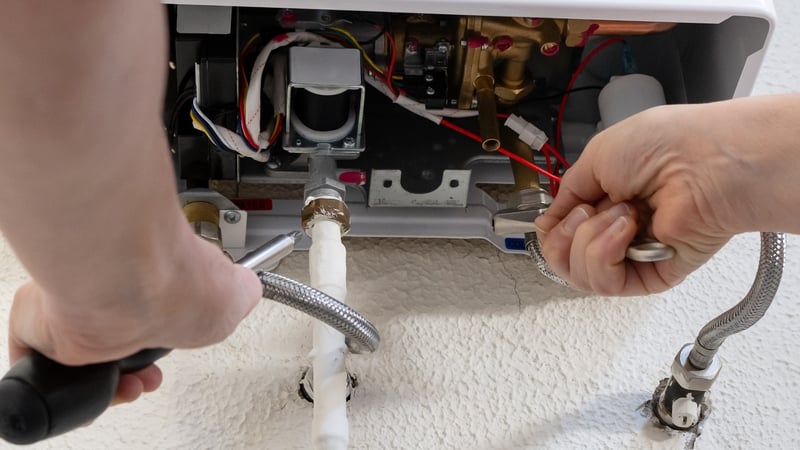
The Government's proposed €2,000 grant to scrap kerosene and oil boilers will "partially" help to address the fundamental issue of overdependence on fossil fuels, an expert in sustainable energy has said.
Professor of Sustainable Energy at University College Cork Hannah Daly said that the grant, which was announced yesterday by Minister for Energy Darragh O'Brien, was welcome as it closes the gap towards affording heat pumps for a lot of people, "partially at least".
If approved at Cabinet, the scheme will come into effect from January 2027.
Speaking on RTÉ's Morning Ireland, Prof Daly added that it is the only proposal that "treats the fundamental problem, which is our oil dependence".
"We're dealing with a legacy of housing that was built as if oil would always be plentiful, cheap and benign for the climate," she said.
"The lesson really should be obvious that the problem is 700,000 homes are dependent on heating oil, which has gotten painfully expensive because of this new war.
"The war in Iran has added about €700 to the price of a tank of oil. And that's a huge cost for many people.
"It's going to be a very painful winter for those people who can’t afford oil."
Prof Daly said that retrofitting homes and heating them through heat pumps was a "fundamental solution" to many issues.
She said that burning fossil fuels was "very harmful for the climate and it leaves households in a very insecure and vulnerable position.
"The only fundamental solution to all of those things, to climate, to security, to affordability, is to move away from oil.
"Deep retrofit is the answer and electrifying with heat pumps because heat pumps effectively draw energy for free from the environment using electricity.
"And that electricity can come from Ireland's native renewable energy, so we don't have to import, we don't have to be so energy insecure and dependent."
We need your consent to load this rte-player contentWe use rte-player to manage extra content that can set cookies on your device and collect data about your activity. Please review their details and accept them to load the content.Manage Preferences
Many homes may already be 'heat-pump ready'
Prof Daly said that she would advise anyone considering upgrades to their home "not to assume that your house needs very deep invasive changes.
"Any house that has done some insulation, maybe has had windows changed in the last couple of years or last decade, they may already be heat pump ready.
"I think we often talk about the real complexity and the difficult nature of retrofit, and I'm not denying that, but many homes are actually much closer to being able to take a heat pump than they would think.
"Also, effective insulation makes your house much warmer, cozier and healthier as well as being secure and less carbon polluting.
"So, all of these measures can support you to have a healthier, more comfortable life as well. We shouldn't just see this as a sort of a climate punishment.
"This is about having secure, clean energy."
'Richest households' benefit most from broad supports
Prof Daly accepted that there are legitimate concerns around the cost of retrofitting and said that targeted energy supports were also necessary.
"Many people won't be able to access that grant if they rent or if they live in a social home, or if they just don't have the resources to do a deep retrofit. It's a complex and it's a costly thing to do.
"So, the Government can't leave it to retrofit alone in the short term.
"They do need to give targeted cost of living supports to people who can't afford to heat their homes, because it's going to be a very painful winter for the people who can't afford oil."
However, she said that "all independent advice to the Government says that these broad blanket supports, like the excise duty cuts or the universal energy credits, are costly, and they don't go to the people who need it the most.
"I would say the same about cutting the carbon tax. The Climate Change Advisory Council, the Just Transition Commission, research from the ESRI shows that fuel support measures should be targeted at fuel poor households through social protection measures and through the fuel allowance.
"So, the cost of cutting the excise duty, for example, on petrol and diesel that was done earlier this year in the first response to the oil shock. It benefits the richest households most because they're the ones who use most oil."
