


Chef and restauranteur Marco Pierre White joined Brendan O'Connor to discuss his pivot from restaurants into curating a hotel, his ongoing quest to recreate his childhood and how to cook the perfect steak. Listen back above.
Formerly known as the enfant terrible of cooking, as well as making history as the youngest chef ever to win three Michelin stars, Marco Pierre White is still a towering figure in the food industry.
However, after handing back his stars and giving up cooking professionally, White has channelled his creative and romantic ideals into a new venture: a luxury hotel just outside of Bath in the UK. The chef acquired the Rudloe Hall Hotel in 2012 and reopened it as the Rudloe Arms in 2013, and has been slowly developing the property into his vision of opulence and luxury since.
Speaking to O'Connor, White says "it's the most challenging job of my life".

"When you build a restaurant, it’s a front room with a kitchen. When you’re building a 60-bedroom hotel and you’ve made that decision that every individual item has to be chosen, it’s a massive job."
He explains that he collects furnishings and uses them to build "giant jigsaws" of design in the hotel, adding that, "what I did with food I now do with design". He mentions one room he's working on at the moment, for which he's bought artwork from Andy Warhol's Chairman Mao collection, which he's pairing with Mouseman furniture.
"I build nests, I don’t build bedrooms", he tells O'Connor.
Speaking about the compulsion to create and design, White explains that he believes he is "rebuilding [his] childhood" through the projects. It's a type of work that connects him to his mother, who passed away suddenly when White was just six years-old.
"I think by talking about my mum, by continuing my mother’s work, she still lives within me. If you don’t talk about your mother when she’s gone, or your father, then they die slowly."
Recalling his tempestuous years as one of the most respected but feared chefs in the food industry, White says that, "Gastronomy is the greatest form of therapy any individual can ever be exposed to, because you teach yourself to speak with your fingers and you slowly grow". It was particularly helpful in easing the pain of losing his mother young.
"Cooking was a stepping stone, it took me to where I went, and now I use building a hotel, developing the grounds, as another stepping stone to me discovering myself. For me success is all about self-discovery. It's not about money, it’s not about Michelin stars. It’s about self-discovery."
As for whether he feels he would survive in modern fine dining kitchens today, White says he would "find it very boring".
"It’s very sterile. It lacks romance. I came from a very romantic world, when the world was run by individuals, not by accountants.
"I chose to be a romanticist, that’s why I do what I do. Yes, I could have chosen to be a businessman, but that didn’t excite me, that didn’t turn me on, that didn’t take me where I wanted to go. What’s important to me is the romance of gastronomy, because the only thing within our industry that never dates is romance."
Years after storming through restaurant kitchens and kicking customers of out of his dining rooms, White says that, "I’m at one with myself. I’ve never been happier in my life".
Now, he says, "I just crave normality".
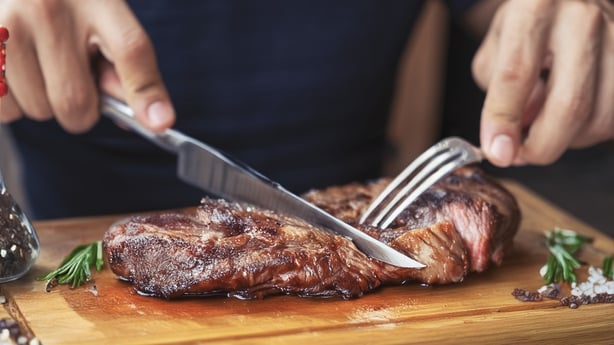
And what combines 'normality' and 'romance' more than mastering the art of cooking something well? It's no wonder, then, that O'Connor asked White for his tips on cooking the perfect steak.
First things first, he says, is buying a high quality cast iron pan. "It’s a small investment, but it enriches your life."
Season your steak just before cooking to avoid drawing the blood and juices out.
Using clarified butter or ghee, so that it doesn't burn, heat the pan to a higher temperature than you need it: "Once you place the steaks inside the pan the temperature of the pan drops. If you put a steak in a pan [and] it goes grey, it just boils, one, the pan’s wrong. Second, the temperature is wrong."
Caramelise the steak to the point that you want it, giving it a quick check underneath, and then flip it. "For me at home, I turn off the gas" at that point, White says, to leave the steak cook in its residual heat.
"At the same time you're doing two things: you’re finishing off the cooking and you’re resting", he says.
"When you start to see the blood pierce the surface, then you know it’s perfectly medium rare. You don’t have to touch it, you don’t have to play with it."
Serve the steak like White does: whole on a platter, with a splash of olive oil, crystal salt and a squeeze of lemon.
