


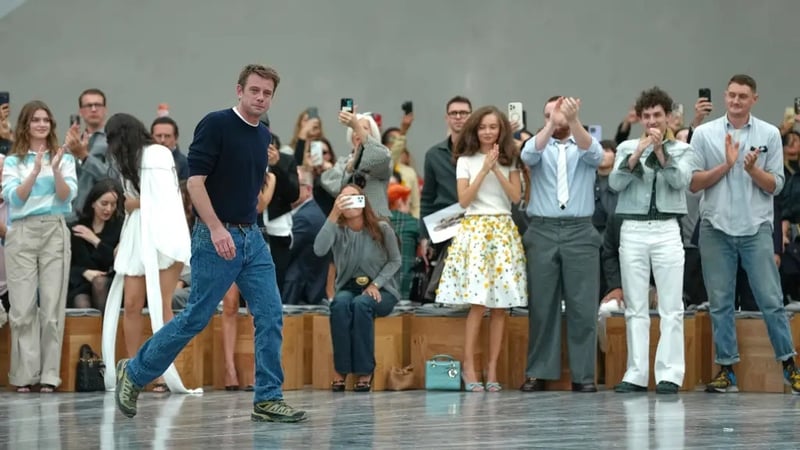

Of all the strange and surprising sights that the hallowed cobbles of Trinity College have seen over the years, a Dior fashion show might be one of the most unexpected.
Thanks to Jonathan Anderson - the Creative Director of the iconic fashion brand - the university's famous Long Room will host the unveiling of the Dior Fall/Winter 2027 collection on December 4th. It’s a huge moment for Irish culture. A major fashion house has never staged a show like this on Irish soil, but the Derry-born Anderson has always been fiercely proud of his Irish roots - even wearing an Irish rugby jersey on the runway on one occasion. Perhaps this Dior-comes-to-Dublin show is his way of throwing the ladder down; he’s paying homage to his roots, but also saying to the world 'Hey, look! Not only are we great at music, writing, acting and all the rest, but the Irish have made our mark on the fashion world, too!’
We need your consent to load this rte-player contentWe use rte-player to manage extra content that can set cookies on your device and collect data about your activity. Please review their details and accept them to load the content.Manage Preferences
Listen: RTÉ Arena on Dior's Irish connection
It’s perhaps fortuitous that the Dior show takes place on the grounds of Trinity College, considering the much-talked-about Green Wave, or at least this most recent iteration of it, arguably began with Sally Rooney. Not only were the Mayo author’s Trinity-set novels a global phenomenon, but the TV adaptation of Normal People even had the Kardashians talking about it. It made Paul Mescal a star, spawned a plethora of literary imitators, got Gen Z talking about Irish culture and, well... the rest is history.

We’ve spoken at length about our success across the arts on the global stage in recent years, that aforementioned Green Wave. Now another crest seems to be on the near horizon - whether it’s in the form of fashion (look at young designers like Oran O’Reilly, Róisín Pierce and Cúpla Designs alongside established kingpins like Anderson and Simone Rocha), music (the unanticipated folk and trad revival, with young bands like Madra Salach putting a contemporary spin on trad songs), or literature, with authors like Djamel White making the Booker Prize longlist with his first novel.
The Irish cultural renaissance continues apace, as long as we continue to water the soil.
Like fruit flies hovering around a compost caddy during a heatwave, we just refuse to go away. Indeed, one of the most defining characteristics of this new surge of Irish culture is that our artists aren’t interested in following global trends - instead, they’re setting their own and boldly offering Irish perspectives to the world, rather than dumbing down their Irishness for UK or US audiences. Never again shall an Aran jumper, a pint of Guinness or a shillelagh be used as a lazy symbol for Irish culture.

This second crest is particularly timely, considering the recent launch of Cultúr 2026, the programme of cultural events which was recently launched in conjunction with Ireland’s EU Presidency, which will provide €5 million to Irish artists and arts organisations and showcase our creative talent all across the EU with events running until December.
And there was more good news for Irish arts earlier this year when it was revealed that the Basic Income for the Arts scheme, which had been run on a pilot basis since 2022, would be made permanent - supporting 2,000 artists across various disciplines for the next three years. This will undoubtedly have a huge impact on our continued success in future years; anyone who has attempted to make art of any kind while simultaneously holding down a job that pays the bills will know how huge this scheme really is. The fact that Ireland is the first country in the world to roll out such a scheme to financially support our artists is a source of pride in its own right.
It goes without saying that it’s hugely important that the BIA scheme continues, and can hopefully eventually expand beyond the 2,000 artists currently availing of it. If we want the world to continue to know about our creative talent, we need to nurture and encourage it. That goes for similar funding schemes like the Small Scale Local Festivals and Summer Schools fund recently approved by Minister Patrick O’Donovan, which awarded over €375,000 to 105 small-scale events taking place this year; 105 events which may not have taken place without that money. I may be biased on this one, but having co-founded a small literary festival this year myself, it hit home how important these kinds of events are to local communities who can often feel bypassed in favour of bigger towns, bigger events and bigger names.

We all have a right to participate in cultural life, so as the next crest of the Green Wave continues to rise - be it with the big moments like a Dior fashion show in Trinity College, Paul Mescal’s inevitable future Oscar-winning role, a promising artist given the time and space to craft what might be a #1 hit album, or simply a cultural event in your local village that might spark an idea or inspire someone - it’s worth remembering the saying: mighty oaks from little acorns grow. The Irish cultural renaissance continues apace, as long as we continue to water the soil.
