


"The mobilization has taken on unexpected proportions": how the high school blockade movement spread across France
The mobilization involved 356 institutions across France on Wednesday. The Student Union called for a "second act" on Thursday and a day of action on October 6.
More resources, smaller classes, better-maintained buildings. For several days now, high school students have been voicing their demands by blocking their institutions. Créteil, Paris, Lille, Marseille, Brest, Strasbourg... The movement concerned 356 institutions across France on Wednesday, September 30, at 6 p.m., compared to 338 on Tuesday, according to the Ministry of the Interior. The Student Union (USL) has called for a "second act" on Thursday and a day of action on Tuesday, October 6.
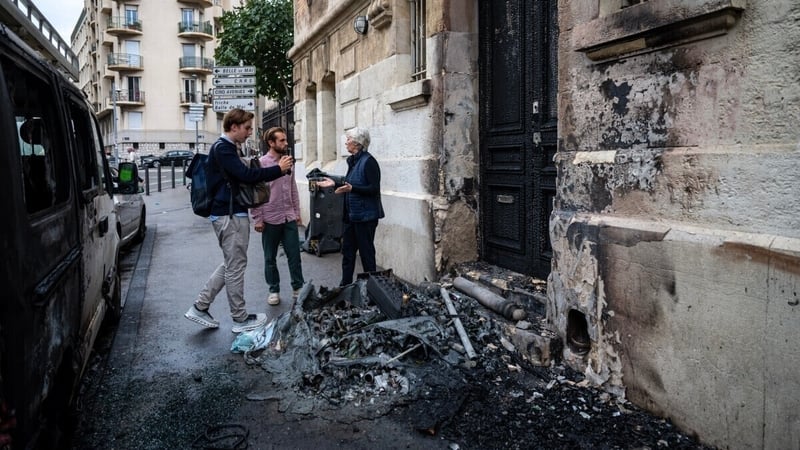
The situation escalated on Thursday morning, with several fires in front of schools and skirmishes between students and law enforcement. In response to this situation, Prime Minister Sébastien Lecornu is presiding over an interministerial crisis unit on Thursday at 1 p.m. at Matignon.
Créteil, in the Parisian suburbs, the epicenter of the mobilization.
Initial blockades began shortly after the school year started. First in Brittany, at the Théodore-Monod high school in Rheu, near Rennes, where "human and material problems" are being reported by students. Then, on September 15, at the Queneau high school in Villeneuve-d'Ascq (Nord) and the Victor-Hugo high school in Caen (Calvados), where the overcrowded timetables are the main cause of discontent.
However, it is in Créteil, in Val-de-Marne, near Paris, that the movement crystallizes. Following a teacher strike against the lack of resources and staff on September 17, the students of Saint-Exupéry high school took the initiative to organize a blockade. "The teachers explained to us the reasons for their discontent and we decided to join them," explains Cheick Sanogo, a first-year student at this institution, to franceinfo. They feel neglected by the National Education and denounce "the lack of resources and staff, overcrowded classes, and a shortage of desks in some classrooms."
A movement amplified by social media
An academic source and the Student Union present this mobilization as the starting point of the national movement. With social media, "the mobilization took on unexpected proportions," testifies Cheick Sanogo. "It's circulating on TikTok, Snapchat, Instagram, and it's getting a lot of views," notes the 17-year-old.
Content is posted by the students themselves, but also by online media, such as Booska-P, which gives a voice to eight students from Saint-Exupéry high school. They share their feelings of abandonment as young people living in the suburbs and explain how they decided to block their institution. "I invite all high schools to do this," concludes one of them. Their interview, published on September 24, totals 1.4 million views on TikTok. "It may have reached other students who are in the same situation as us, or even worse," estimates Cheick Sanogo. "Social media acts as a mobilization amplifier and exposes various forms of appropriation," states the Créteil academy on September 28.
MPs coming to support.
Meanwhile, politicians are seizing the mobilization of this high school in Créteil. On September 21, Louis Boyard and Clémence Guetté, two deputies from the La France insoumise group, visit the site. On X, Louis Boyard's post receives nearly 520,000 views. "Having important people, elected representatives of the Republic, come to support us makes us happy. We feel more listened to," confides Cheick Sanogo.
The movement quickly spreads to the suburbs of Paris. On September 25, the rectorship of the Créteil academy identifies a "large ten" high schools that were blocked, particularly in Seine-Saint-Denis and Val-de-Marne. The Versailles academy also reports "disruptions" in three institutions in Essonne.
Gradually, the mobilization begins to organize. In a statement shared on social media, the USL calls for a national mobilization on Tuesday, September 29, against the "lack of teachers and staff," "dilapidated high schools," "overloaded timetables and classes," and the "stress caused by Parcoursup." It also invites students to join the demonstrations for public service. In 2025, the USL had already called for a national blockade of high schools for the same reasons. According to the organization, it was followed by 170 institutions at that time.
"Unprecedented in the National Education System."
During a press conference on Wednesday, Interior Minister Laurent Nuñez mentioned the presence of "hooded people, dressed in black, armed with projectiles, mortars, and sometimes bottles of hydrochloric acid" near the blockades. "Groups (...) are trying to provoke disruptions and blockades by moving from one institution to another. (...) Some are extremely violent," said National Education Minister Edouard Geffray. Since the start of the blockades, 119 people (85 students and 34 staff members) have been injured. "It's unprecedented in the National Education System," lamented Edouard Geffray before journalists. In two days, Tuesday and Wednesday, law enforcement made 1,065 arrests.
On Monday, a high school student was injured in the face by a projectile fired by a police officer during a blockade in Saint-Ouen-l'Aumône, in Val-d'Oise. The scene was filmed. On social media, the images shock and garner thousands of views. The next day, at student gatherings, teenagers brandish placards denouncing police violence. This is the case of Jasmine, a student in Paris: "I am protesting in support of suburban high schools that have been repressed," she explains to franceinfo in front of her school in the 3rd arrondissement.
The government and LFI are passing the buck.
In this tense context, the government and La France Insoumise are accusing each other of fueling tensions. Jean-Luc Mélenchon reproaches to the executive on X for having ordered the repression with "an obvious racist aftertaste." "LFI deputies are encouraging (...) young people to block high schools," asserts the Minister of National Education on September 25 on X. "We cannot demand more teachers and encourage blockades that prevent students from attending classes," he judges. Three days later, Prime Minister Sébastien Lecornu criticizes "irresponsible escalation": "Instrumentalizing their anger for partisan purposes is a mistake," he believes. "The rebels call for non-violent methods of struggle," assures Jean-Luc Mélenchon on X.
In response to the anger, the government announced on Wednesday the opening of a "consultation platform" for high school students to share their "concerns" and "demands." It will be accessible "on Monday, or Tuesday morning at the latest." In the meantime, the movement continues to grow. The three main student organizations, Fage, the Student Union, and Unef, are calling for demonstrations and blockades.
An article written by Lucie Rivière (franceinfo), initially published on 1 October 2026, 13:24 (CEST)
