


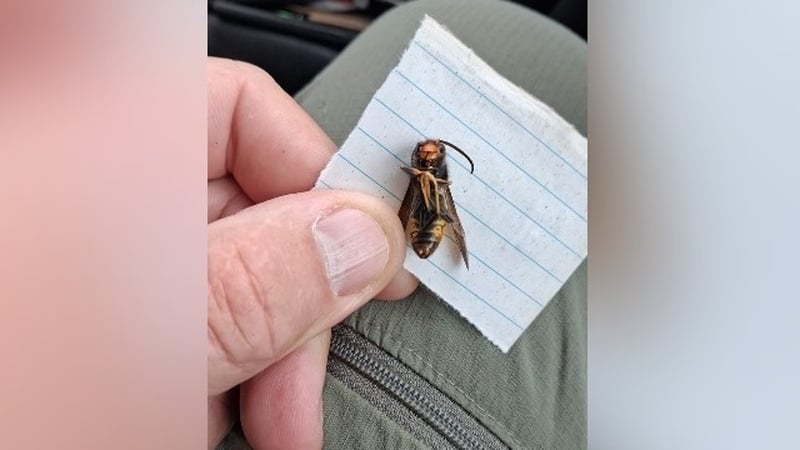

An intensive surveillance and monitoring operation to locate and remove an Asian hornet nest in the Ringaskiddy area of Co Cork is under way, according to Minister for Nature, Heritage and Biodiversity Christopher O'Sullivan.
The operation, which is being conducted by the National Parks and Wildlife Service (NPWS), was escalated following the successful capture of a second Asian hornet yesterday close to the location where an initial specimen was photographed by a member of the public late last week.
The minister said he has strong confidence that a rapid response team searching for the Asian hornet nest in Ringaskiddy will succeed in locating it.
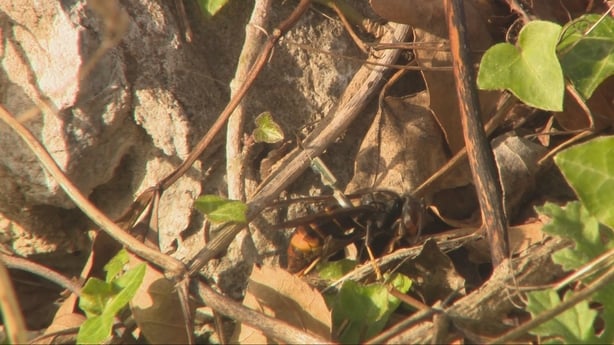
Conservation rangers said they are now certain there is a nest in the area after catching an Asian hornet in a trap today and observing others foraging among ivy around a disused building close to the search site.
Watch: Asian hornet discovered in Cork
Experts from the National Parks and Wildlife Service and the National Biodiversity Data Centre have been on the ground since yesterday evening trying to track the much-feared invasive species back to its nest.
NPWS conservation rangers successfully attached a tiny transmitter to the back of an Asian hornet.
The Asian hornet was allowed to then fly away as the team follows its radio signal in the hope that it leads conservation rangers directly back to the nest.
They initially laid traps to catch the insects and confirm that Asian hornets were present in the area.
After one was caught and positively identified earlier today, the team switched to using bait stations containing sweet syrup and meat to attract live hornets.
They succeeded in painting a coloured tracking spot onto the back of at least one live hornet at a bait station and watched as it flew away.
The aim was to observe marked hornets returning to the bait stations.
This was done in order to confirm the insects are foraging for a nest, establish the direction in which they are flying and help the team narrow down the location of the nest.
However, the search was complicated by the presence of large amounts of ripened ivy around a disused building in the area, which is providing an abundant natural food source and proving highly attractive to the hornets.
In an effort to lure them away from the ivy and towards the bait stations, the rangers have been spraying a very sweet pink syrup into the air.
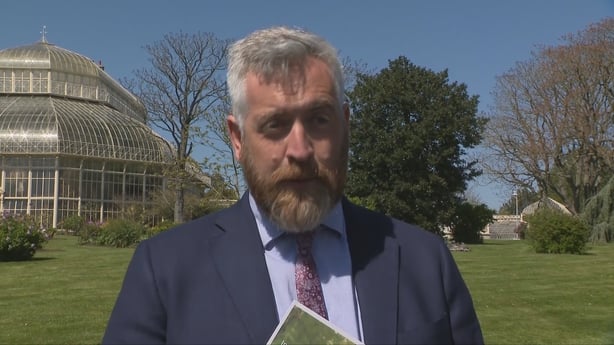
Minister O’Sullivan said it was important the nest is located and destroyed as quickly as possible.
He warned that allowing the invasive species to become established in Ireland could have a devastating impact on native ecology.
The minister said: "These are voracious predators.
"They predate on our native pollinators, including bumblebees, solitary bees and hoverflies.
"These are species that are so important to the entire ecology of Ireland.
"But of course, there's also an impact on honeybees.
"We know that there's a very vibrant and close community of beekeepers here in Ireland, and they see this as a threat as well."
Mr O'Sullivan added that the matter is "double-edged".
"It's our own native wildlife, our own flora and fauna that these guys pose a serious threat to," he said.
"But also, to our beekeepers as well, who have been so supportive in our efforts so far," he added.
NPWS conservation ranger Sam Bailey said once the nest is located, it will be treated with chemicals by a specialist team to destroy the colony.
The ranger said: "The nest is then controlled, then removed and taken away, and we can then start doing DNA studies and whatever research we need to on those animals.
"That is because we can work out where they came from.
"We need to know if they are related to the Asian hornet population found in Cork last year.
"Although we think that is unlikely, we still have to check.
"Are they hornets that came from Europe? Could they have potentially come directly from China?
"There's lots of different elements that we need to work out to help us deal with things further down the line."
Mr O'Sullivan said the use of this latest transmitter technology has proven highly successful in other countries, including the UK, and gives the best possible chance of locating the nest before the species can establish itself.
"We know from our successful response to last year's incursion that early detection and rapid intervention are absolutely critical. Using the latest science, technology and expertise, we are moving swiftly and decisively to protect Ireland's biodiversity and our native pollinators from this invasive species," he said.
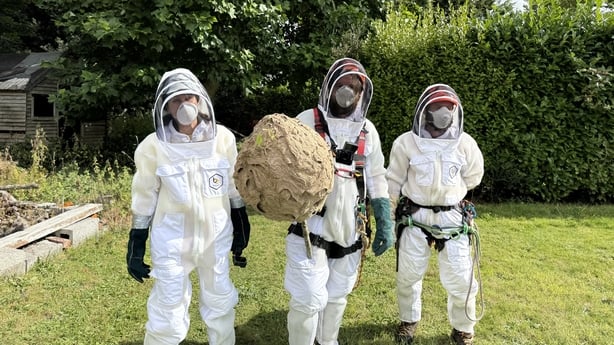
It is important that any nest can be located and neutralised quickly before any young queen hornets depart at this time of the year.
If they get out, they will spend winter outside the nest before starting new colonies of their own in the spring.
Asian hornets are an invasive apex insect predator that feed on pollinators and particularly like to eat honeybees.
Irish honeybees have no experience of such a predator and, so, are very exposed.
It is estimated that a single Asian hornet nest would consume about 11kg of pollinator insects in a single season.
Mr O'Sullivan said he wants to thank members of the public whose vigilance helped to bring this issue to the attention of the NPWS.
He added that public awareness remains one of the strongest defences.
"I would encourage anyone who believes they may have seen an Asian hornet to report it immediately through the website www.invasives.ie," he said.